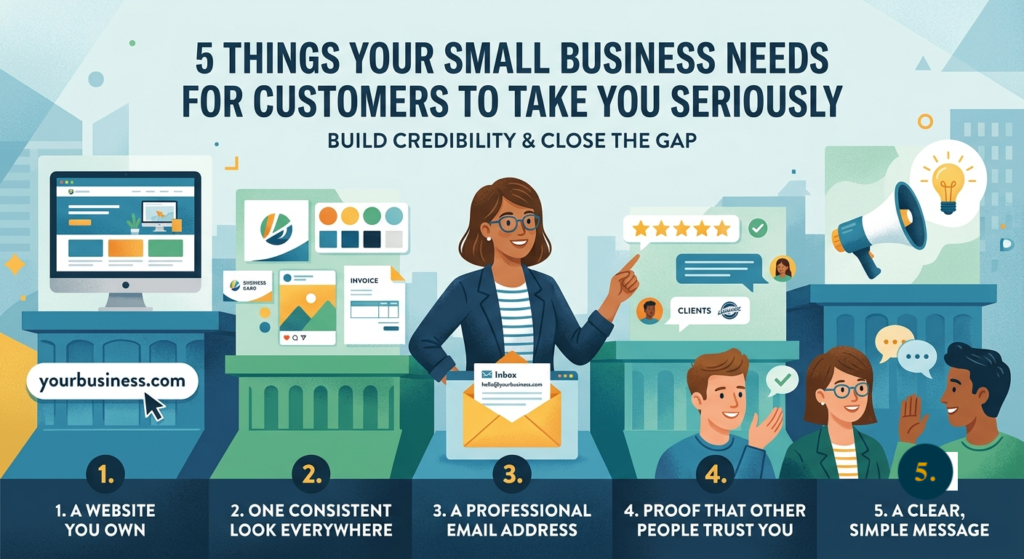
Most small businesses don’t lose customers because their product is bad. They lose them in the first ten seconds — the moment a potential customer forms a snap judgment about whether you’re the real deal. Credibility is what closes that gap, and the good news is that it’s built from a handful of deliberate, repeatable choices. Here are five that move you from “maybe” to “let’s talk.”
1. A website you actually own
A social media page is borrowed land. The algorithm decides who sees you, the platform can change the rules overnight, and you can’t fully shape the experience. A real website (one you own, on your own domain) is the one place online that is entirely yours. It signals permanence: a business with a proper site looks like it plans to be around next year.
It doesn’t need to be huge. A clear homepage, a page about what you do, real examples of your work, and an obvious way to get in touch will outperform a sprawling site nobody finishes reading.
2. One consistent look everywhere
When your logo, colors, and fonts are different on your website, your invoices, and your Instagram, customers feel it even if they can’t name it. Inconsistency reads as “small and scrappy”; consistency reads as “organized and trustworthy.” Pick a simple visual identity (a couple of colors, one or two typefaces, and a logo that works small) and use it the same way, every time. Repetition is what turns a name into a brand people remember.
3. A professional email address
Few things undercut a business faster than a generic free email address on a quote. An address at your own domain (like hello@yourbusiness.com) costs a few dollars a month and instantly tells customers you’ve invested in your business. It’s one of the cheapest credibility upgrades available, and it pairs naturally with the website you already own.
4. Proof that other people trust you
People believe other customers far more than they believe your marketing. That’s social proof, and it’s the quiet engine behind most buying decisions. Collect and display it deliberately: reviews on Google, short testimonials with a real name and photo, logos of clients you’ve worked with, before-and-after examples, or a simple count of projects completed. A few specific, believable endorsements do more than any amount of self-description.
5. A clear, simple message
If a stranger can’t tell what you do and who you do it for within a few seconds of landing on your site, you’ve lost them. Skip the clever tagline and lead with plain language: what you offer, who it’s for, and what they should do next. One strong sentence at the top of your homepage does more work than three paragraphs of buzzwords. Clarity is a form of respect for your customer’s time, and customers reward it with attention.
Putting it together
None of these require a big budget; they require INTENTION. Get the five working together and you stop looking like a hobby and start looking like a business people can hand their money to with confidence. If you’d like help putting them in place, that’s exactly the kind of work we do.
Noted. Small business owners really need to make sure their brand looks good online.